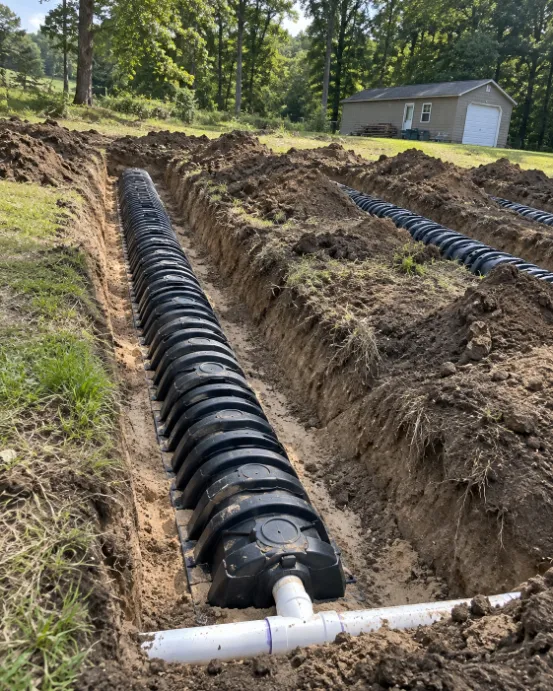
Tank and Field Diagnosed Together
Robles inspects both the septic tank and the drain field to identify which one is actually causing the problem.

Robles Drain & Construction, LLC provides drain field service and repair across the Portland Metro area and the wider Portland/Vancouver area. Robles is a licensed, insured, family owned drain and sewer specialist with more than 15 years of experience, diagnosing the actual cause of a failing drain field before recommending a repair or a full replacement.
A struggling drain field rarely fixes itself, and it's easy to assume the worst before anyone has actually looked at it. Robles inspects the tank and the field together, tells you which one is actually failing, and explains the real options before any work starts.
Robles provides drain field service throughout the Portland Metro area and the surrounding areas that rely on a septic system for wastewater disposal.
The drain field, sometimes called the soil absorption area or leach field, is where wastewater from the septic tank gets dispersed into the surrounding soil after the tank has separated out solids. When that soil can no longer absorb wastewater properly, whether from saturation, age, or damage, the whole system backs up even if the tank itself is in good condition. Robles diagnoses the drain field the same way it approaches every drain and sewer job: find the actual cause first, then present real options.
Robles inspects both the septic tank and the drain field to identify which one is actually causing the problem.
Repair, partial repair, or full replacement get presented based on what the inspection actually shows.
Robles carries the license and insurance drain field work in Oregon and Washington requires.
A failing drain field is not something to guess on. Robles treats every drain field call with the same documentation-first approach used on every septic and sewer job.
Tank or field
Which one is actually failing
Repair first
Where the failure hasn't spread
Permits
Site Evaluation Report managed for you
Robles inspects both the tank and the drain field on every call, since the two failures look similar to a homeowner but need very different fixes.
Excess sludge or scum inside the tank, a tank that's reached capacity, or an inlet and outlet that aren't working correctly. If the tank can't separate solids properly, debris moves downstream into the drain field.
Oversaturated soil, sewage odor in the yard, or slow drains and backups that persist even shortly after the tank has been pumped. This points to the soil itself, not the tank.
A full tank can sometimes mimic a failing drain field, and a failing drain field can sometimes get blamed on a tank that just needs pumping. Robles inspects both before recommending a fix, so the repair matches the actual problem.
Robles hears the same warning signs on drain field calls throughout the Portland/Vancouver area and surrounding areas, often before the system backs up completely.
Wet, mushy, or spongy ground over the drain field area
Unusually green or fast-growing grass directly above the field
A sewage odor in the yard, especially after rain
Slow drains throughout the house even shortly after the tank was pumped
Sewage backing up into the home
Standing water pooling near the drain field after normal household use
Portland's wet season adds pressure to a drain field that's already struggling. Ground that's already saturated from rain has less capacity to absorb more wastewater, which is why some drain field problems that seem minor in summer turn into a full backup once the rain sets in.
Robles sees a consistent set of causes behind drain field failure on calls across the Portland Metro/Vancouver area.
Soil that can no longer absorb wastewater at the rate it arrives.
A buildup inside the soil that has thickened enough to block drainage.
A septic tank that hasn't been pumped on schedule, letting solids move into the field.
Water use that overwhelms what the soil can absorb at once.
Tree roots intruding into the distribution lines feeding the field.
Vehicles, structures, or heavy equipment compacting the soil above the field.
Most of these build up slowly. A drain field that's been under stress for years from one or more of these causes is a very different repair than a field that failed suddenly from a single event like root intrusion or a broken distribution line.
Robles evaluates the actual condition of a drain field across the Portland Metro area before recommending a repair or a full replacement.
Addresses a localized issue: a broken distribution line, root intrusion in part of the field, or a section that's failing while the rest of the field still works. Often possible when the failure hasn't spread across the whole system.
A full replacement is needed when the field has failed broadly, the soil can no longer support the existing design, or the system no longer meets current standards. This is a bigger project, but not always the first answer.
A drain field replacement in Multnomah County requires a Major Repair Permit and an approved Site Evaluation Report, since the soil and site conditions have to be reassessed before new work can be approved. Robles manages that process as part of the job rather than leaving you to coordinate it separately.
A drain field that's cared for consistently tends to last far longer than one that only gets attention once it's already failing.
Keep vehicles, sheds, decks, and heavy equipment off the drain field area entirely
Avoid planting trees or large shrubs near the field, since roots seek out the moisture in the lines
Have the septic tank pumped on a regular schedule so solids don't move downstream into the field
Spread out heavy water use, like laundry, across the week rather than all at once
Keep grease, chemicals, and non-biodegradable items out of any drain connected to the system
Address a soggy patch or odor early, before it becomes a full field failure
None of this guarantees a drain field will never need service, especially on older Portland Metro area properties. But a field that's protected and maintained consistently is far less likely to need a full replacement than one that's ignored until the yard is soaked.
Wet or spongy ground over the field, unusually green grass in that area, a sewage odor in the yard, and slow drains that persist even after the tank has been pumped are the most common signs. Sewage backing up into the home is the most urgent one. Robles inspects both the tank and the field to confirm which one is actually causing the problem.
It depends on the extent of the failure. A localized issue, like a broken distribution line or root intrusion in one section, can often be repaired without replacing the entire field. A field that has failed broadly, or soil conditions that no longer support the existing design, usually points toward full replacement. Robles evaluates the actual condition before recommending either.
Compacted or saturated soil, a thickened biomat layer blocking drainage, a septic tank that hasn't been pumped on schedule, heavy water use, tree root intrusion, and soil compaction from vehicles or structures over the field are the most common causes Robles sees. Most of these build up over time rather than happening suddenly.
Not necessarily, though they can look similar from inside the house. A tank problem often involves excess sludge or a tank that's reached capacity, while a drain field problem usually shows up as oversaturated soil, sewage odor, or backups that persist even shortly after pumping. Robles inspects both to identify which one is actually failing before recommending a fix.
It can. Soil that's already saturated from rain has less capacity to absorb additional wastewater, which puts more pressure on a drain field that may already be struggling. A field that seemed to be managing fine over the summer can back up once the wetter months set in.
Yes. Drain field replacement in Multnomah County requires a Major Repair Permit, and an approved Site Evaluation Report is required before that permit can be issued. A more limited repair may fall under a different permit category depending on the scope. Robles manages the permit process as part of the job.
Yes. Roots are drawn to the moisture in the distribution lines that feed the drain field, and over time they can intrude into the lines and disrupt how evenly wastewater gets dispersed. This is part of why Robles recommends avoiding new tree plantings near an existing drain field.
A targeted repair to a section of the field can sometimes be completed in a day. A full replacement takes longer, especially once the Site Evaluation Report and permit process are factored in. Robles will give you a realistic timeline once the scope of the work is confirmed.
It depends on the scope. A localized repair to one section of the field involves less disruption than a full replacement, which typically does require excavation across the affected area. Robles will walk you through what to expect for your specific property before work begins.
Yes. Drain field service and repair work from Robles is backed by the company's service guarantee, with documentation from the initial inspection through the completed repair.
Robles Drain & Construction provides drain field service and repair across the Portland Metro area and the wider Portland/Vancouver area, backed by more than 15 years of experience and a real diagnosis on every job.
Whether it's the tank, the field, or both, Robles inspects the system, explains what's actually happening, and presents honest options before any work starts.
Tank and field inspected together on every drain field call.